A Shiny app for InfoSec: which models may see which data
Once a bank lets analysts use language models, someone has to decide which models may see what. Customer PANs to the in-house model on the analyst's laptop: probably fine. To a shared GPU server: perhaps not. To an external provider: no. A card number with its CVV: never. That someone is usually InfoSec or compliance, and they should not have to edit YAML to say it.
credgate keeps these decisions in a policy, and its R package includes a Shiny app to edit one. This post walks through it.
The policy
A policy lists the model endpoints requests may go to, each with a tier -
local (the analyst's machine), internal (models the organisation runs)
or frontier (external providers) - and rules, checked in order, that
decide what happens to each identifier found: allow it, redact it, tokenise
it, or block the whole request.
library(credgate)
policy <- cg_policy("bank-default.yaml")
d <- policy_decide(policy, "Card 4111 1111 1111 1111, CVV 123, expiry 08/29", "claude")
d$allowed      # FALSE
d$blocked_by   # "card-with-cvv-and-expiry"
Loading is strict: an unknown field, tier or identifier type is an error, never a silent "allow".
The editor
# install.packages(c("shiny", "bslib"))
policy_editor("bank-default.yaml")
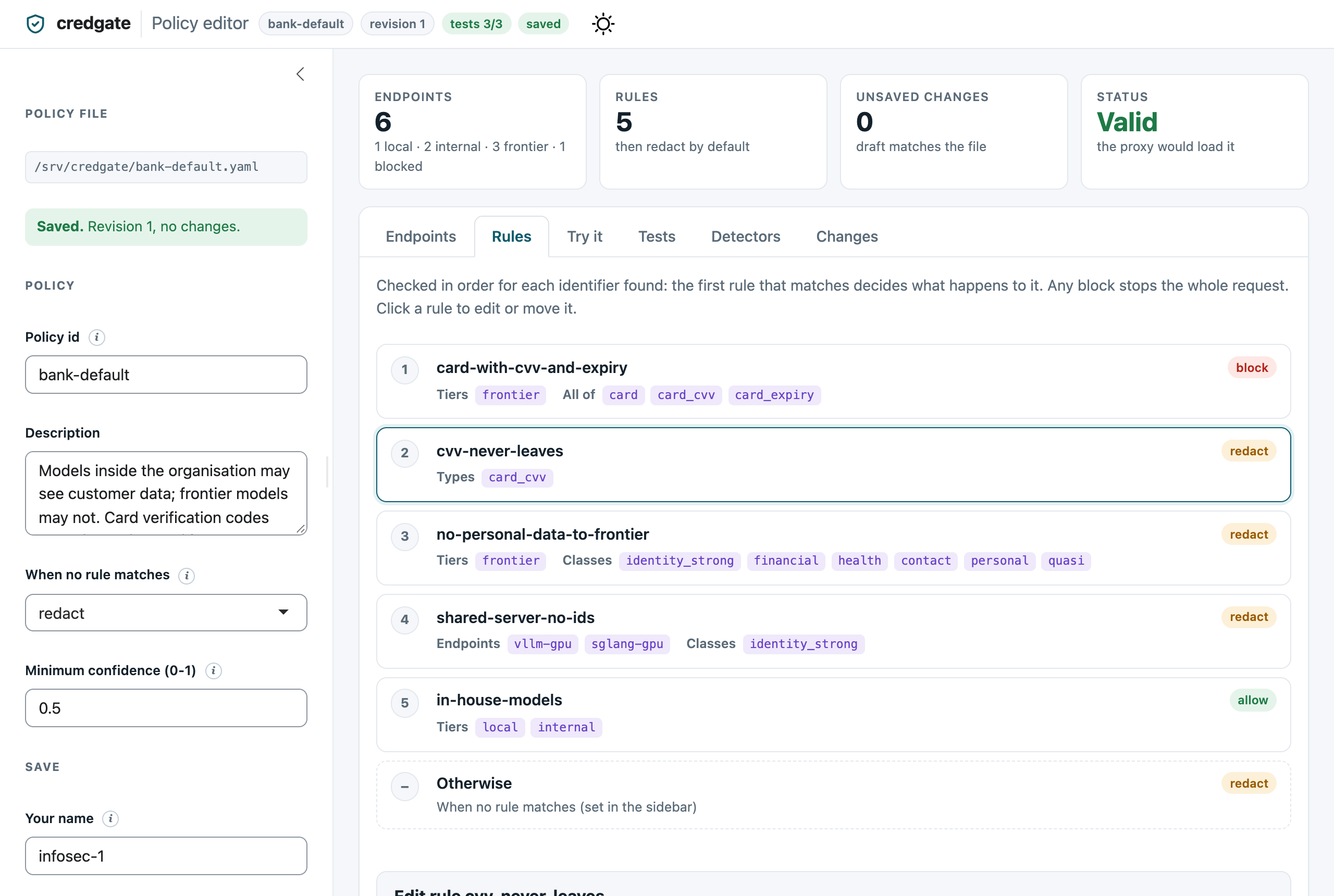
- Endpoints and Rules: add, change, reorder. The first rule that matches decides, so order matters; moving a rule shows straight away what changes.
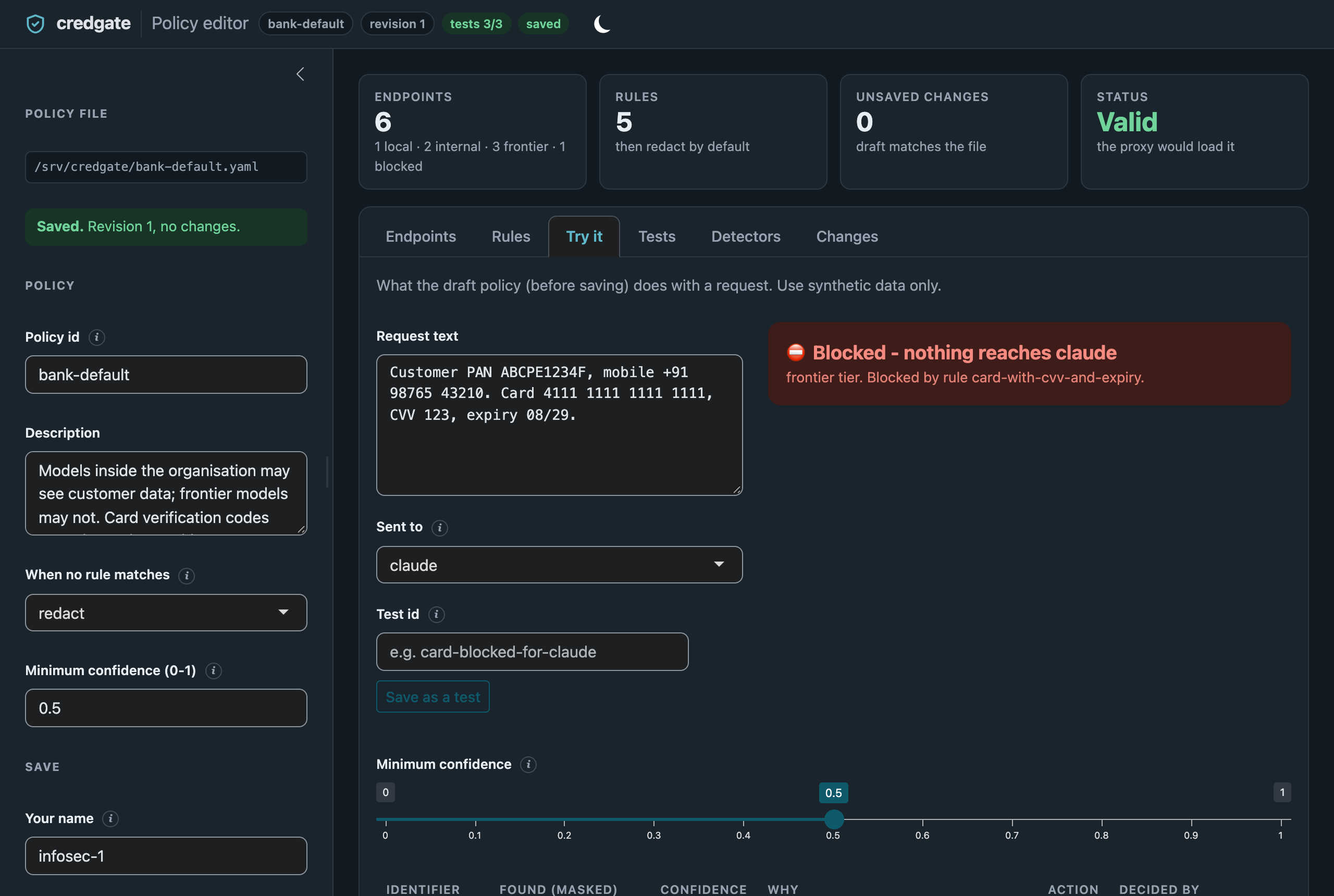
- Try it: paste a synthetic sample, pick an endpoint, and see the decision on the unsaved policy - each identifier, its confidence, why it was found, the action and the rule that decided it. It also lists what looked like an identifier but was not reported, and why (a failed checksum, a missing keyword, a confidence below the minimum).
- Tests: once a decision is right, save it as a test. Every later change runs the tests first; a change that breaks one cannot be saved without saying why.
- Detectors: write and try custom detectors - loan account numbers, staff codes - with a form that generates the YAML.
- Changes: what differs from the saved file, and the change log.
Tests: the behaviour that was agreed
# bank.tests.yaml, beside the policy
kind: credgate-policy-tests
version: 1
tests:
  - id: card-blocked-for-claude
    endpoint: claude
    text: Card 4111 1111 1111 1111, CVV 123, expiry 08/29
    expect: {allowed: false, blocked_by: [card-with-cvv-and-expiry]}
run_policy_tests("bank.yaml")[, c("id", "passed")]
#>                        id passed
#> 1 card-blocked-for-claude   TRUE
The same tests run in CI with credgate policy test, and the proxy refuses
to load a new policy revision whose tests fail.
Every save is on record
Saving raises the policy's revision and appends who saved it, when, why and what changed to a change log beside the policy. Each entry carries the hash of the one before, so an entry edited or removed afterwards is detected.
x <- yaml::read_yaml("bank.yaml")
x$destinations$copilot$blocked <- FALSE
policy_diff(yaml::read_yaml("bank.yaml"), x)
#> [1] "endpoint copilot: blocked true -> false"

policy_write(x, "bank.yaml", user = "priya", note = "CHG-1042 Copilot approved for code")
h <- policy_changes("bank.yaml")
h[, c("revision", "user", "note")]
#>   revision  user                               note
#> 1        2 priya CHG-1042 Copilot approved for code
attr(h, "intact")
#> [1] TRUE
For a whole team
With a users file, the editor shows each person what their role allows, and refuses the rest on the server:
- admins (InfoSec) change the policy;
- auditors see everything and change nothing;
- users (analysts) try the saved policy, see the tests and their own activity, and manage their own key for the credgate proxy - but not the policy's make-up.
Behind single sign-on (OAuth2 Proxy, Keycloak, a web server's SSO module), the signed-in name comes from a header: see the deployment guide. The editor loads nothing from the internet, so it runs air-gapped.
The Python package has the same app (credgate editor), on the same files,
for teams without R.
Try it
credgate is open source (Apache-2.0) and alpha. If you look after AI governance or data protection, we would like to hear what is missing: open a discussion or an issue.
- Install from R-universe (CRAN review in progress)
- The policy editor guide
All values in this post are synthetic.