Using Claude Code on Indian bank data without sending a single PAN
AI coding assistants are most useful exactly where the data is most sensitive. In a bank or an NBFC, the notebooks, logs and call notes that Claude Code reads are full of PAN, Aadhaar and mobile numbers - and RBI guidance, the DPDP Act and PCI DSS all say those should not reach an external model.
This post shows Claude Code running through credgate, an open-source proxy that applies a policy to every request: identifiers are tokenised or redacted before anything leaves the machine, the real values are put back into the answer for you, and every decision is written to a tamper-evident audit log.
The setup: one environment variable
Claude Code sends its model requests to whatever ANTHROPIC_BASE_URL points
at. Point it at the credgate proxy:
pip install credgate
credgate proxy serve --policy bank.yaml --audit audit.jsonl --default-endpoint claude
ANTHROPIC_BASE_URL=http://127.0.0.1:8790 claude
Nothing else changes for the user: Claude Code works as usual, signed in to
their own account. The proxy listens on the analyst's machine only
(127.0.0.1), and --default-endpoint claude sends Claude Code's own model
names to the endpoint called claude in the policy.
The policy: what may go where
The policy is a short YAML file that InfoSec owns. Endpoints have a tier -
local (the analyst's machine), internal (models the bank runs) or
frontier (external providers) - and rules decide what happens to each kind
of identifier, first match wins:
destinations:
  claude: {tier: frontier, provider: anthropic, url: "https://api.anthropic.com/v1"}
rules:
  - id: card-with-cvv-and-expiry
    when: {tiers: [frontier], all_of: [card, card_cvv, card_expiry]}
    action: block
  - id: ids-tokenised
    when: {tiers: [frontier], classes: [identity_strong]}
    action: tokenise
  - id: contact-redacted
    when: {tiers: [frontier], classes: [contact, financial, personal]}
    action: redact
default_action: redact
Tokenise replaces a value with a token such as [PAN_k3xq…] that the
proxy can turn back into the real value in the answer. Redact replaces
it with a label such as [MOBILE_IN], and the value is gone for good.
Block refuses the whole request - here, a card number together with its
CVV and expiry never reaches an external model at all.
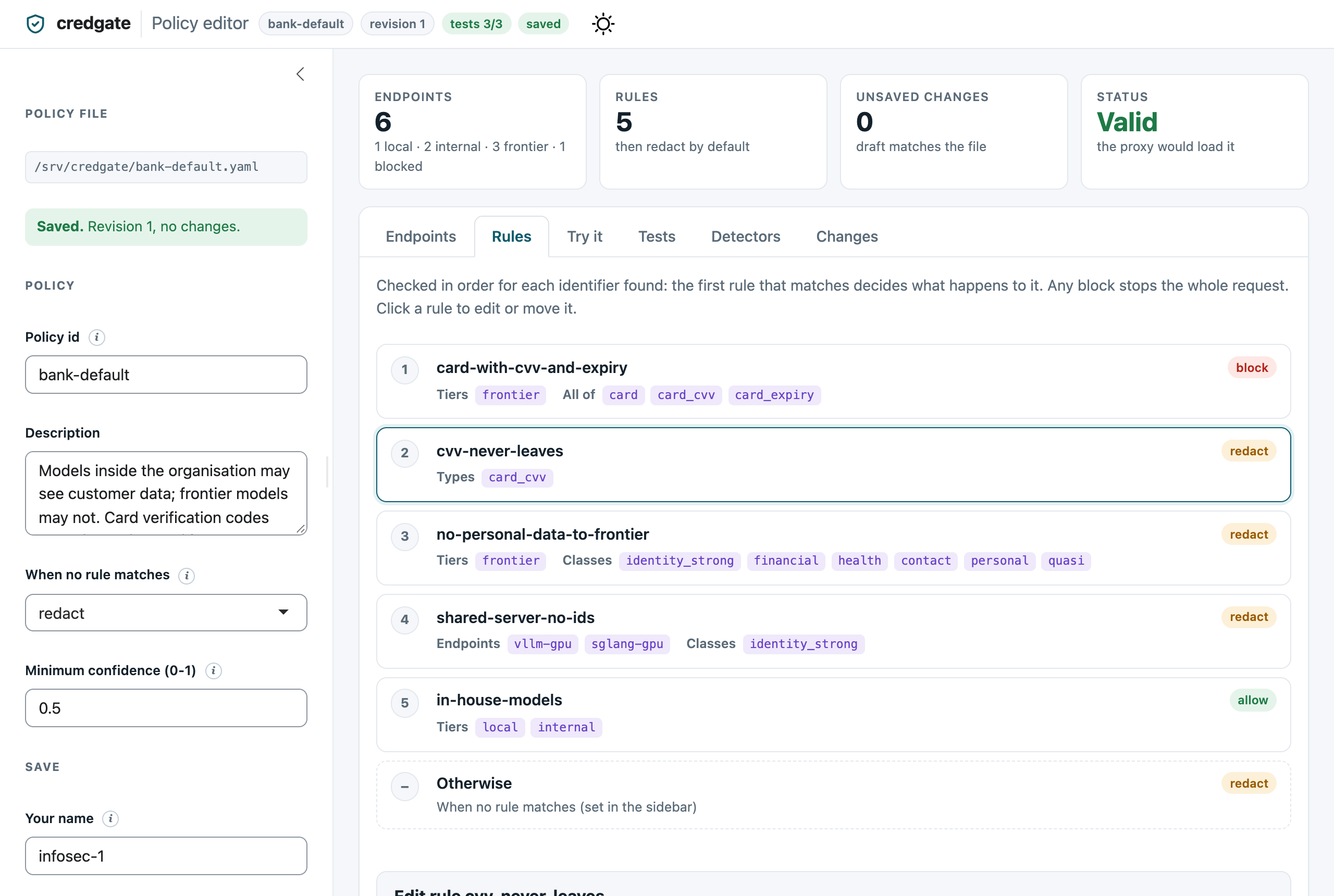
InfoSec does not have to edit YAML by hand. credgate's policy editor shows the rules in the order they are checked, and every save raises the revision and records who changed what, and why:
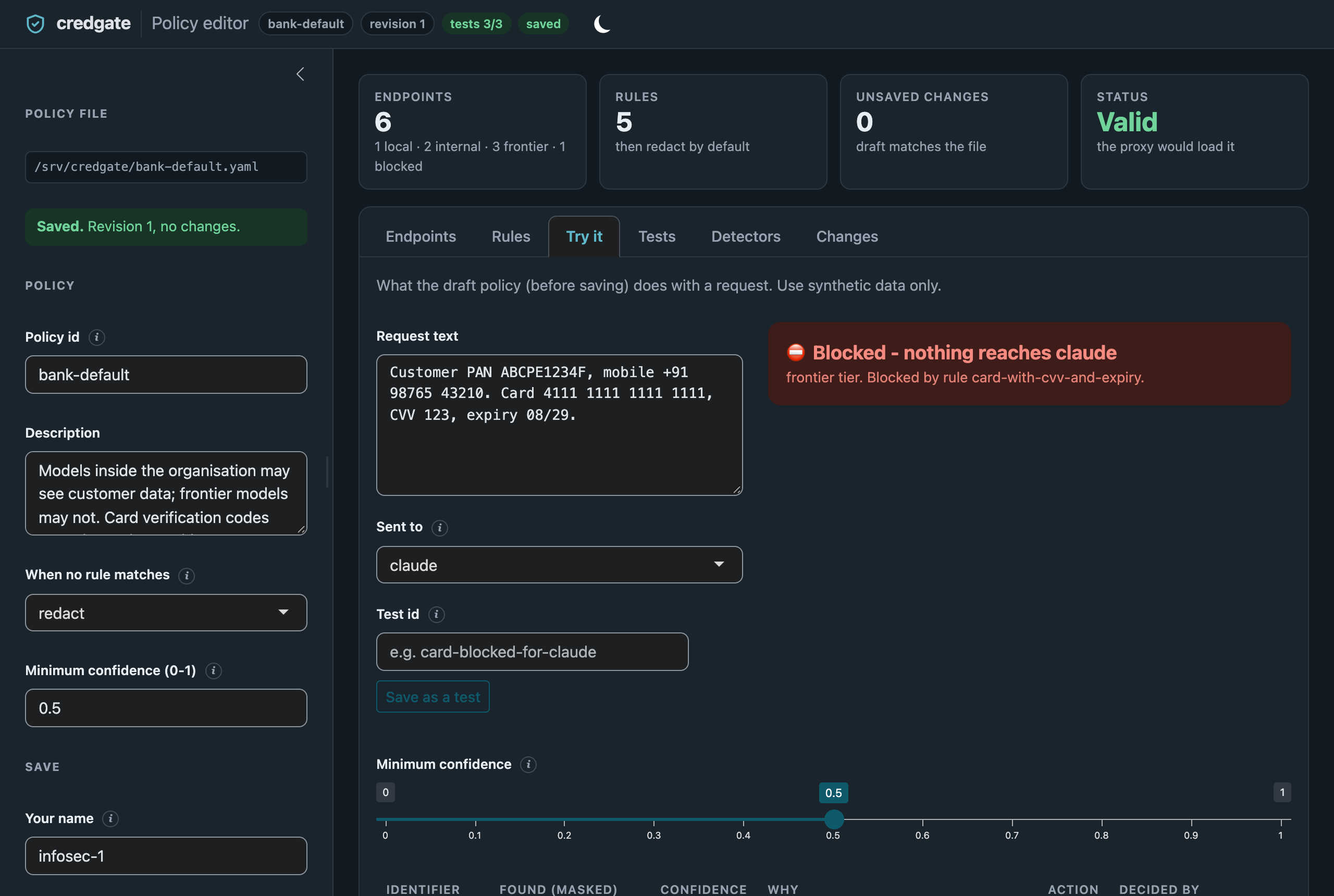
Its Try it tab runs the unsaved policy on sample text before anyone
saves it. A card with its CVV and expiry, sent to claude, is blocked, and
every value is masked even on this screen:
What happened
I asked Claude Code (2.1.309) to repeat a sentence with a synthetic PAN and mobile number:
Repeat this sentence exactly and say nothing else: The customer PAN is ABCPE1234F and mobile 9876543210.
Claude Code answered:
The customer PAN is ABCPE1234F and mobile [MOBILE_IN]
The PAN is back, because it was tokenised: Claude saw only the token, and the proxy restored the value in the answer on its way back to me. The mobile number was redacted, so Claude never saw it and there was nothing to restore.
The audit log has a record for each request, with no values in it (the user name shortened here):
{"seq": 3, "time": "2026-11-02T13:38:39.222Z", "actor": "analyst",
 "policy": {"id": "live-check", "revision": 1},
 "destination": {"name": "claude", "tier": "frontier", "provider": "anthropic"},
 "allowed": true, "blocked_by": [],
 "items": [
   {"type": "pan", "action": "tokenise", "rule": "ids-tokenised"},
   {"type": "mobile_in", "action": "redact", "rule": "contact-redacted"},
   {"type": "person_name", "action": "redact", "rule": "contact-redacted"}],
 "prev": "c4ef87f7…"}
Two things in it surprised me:
- A name was redacted that I never typed. Claude Code adds its own context to every request - a system prompt and details about the working environment, which here included names and e-mail addresses. The proxy checks everything that goes out, not only the prompt, so those were redacted too.
- Every record names the rule that decided it, and
prevholds the hash of the record before. Edit, delete or reorder a record andcredgate.audit_verify()reports exactly where the chain breaks - evidence an auditor can check without trusting the person who kept the log.
How it holds up
- Streaming. Claude Code streams its answers, and a token can arrive
split across pieces (
[PAN_in one,k3xq…]in the next). The proxy holds back a piece that could be the start of a token until the next one shows whether it is, so values are restored correctly while the answer streams. - Fails closed. If detection, the policy or the audit record fails, nothing is sent. Images and files, which credgate cannot check, are refused rather than sent unchecked.
- Checked under load. In the published benchmark the proxy handled tens of thousands of requests with no errors, no wrong answers and no identifier reaching the endpoint; one worker passes on about 9,000 streamed pieces a second.
- Not only Claude Code. The same proxy speaks the OpenAI and Ollama APIs, so VS Code Copilot Chat (with your own models), Open WebUI, ellmer and the SDKs go through it the same way.
What it does not do
credgate is alpha, and honest about its limits:
- It only governs what goes through it. Network rules, not credgate, must make the proxy the only way to reach external models.
- Names without a cue are often missed. "Name: Lakshmi Verma" is found; "Lakshmi Verma called about her loan" is not yet. Prefer policies that redact free text for external models.
- It handles accidental variation, not evasion. Indic digits, hidden characters and mixed case are caught; someone deliberately spelling out a PAN letter by letter is not.
Try it
credgate is open source (Apache-2.0), in Python and R, and runs fully offline:
- Install:
pip install credgate(andpip install 'credgate[server]'for a shared proxy on uvicorn) - Guide: The proxy, including Claude Code and Copilot Chat
- Code and issues: github.com/dwarpal/credgate
All values in this post are synthetic.